
What size battery do I need? How to choose the capacity in kWh
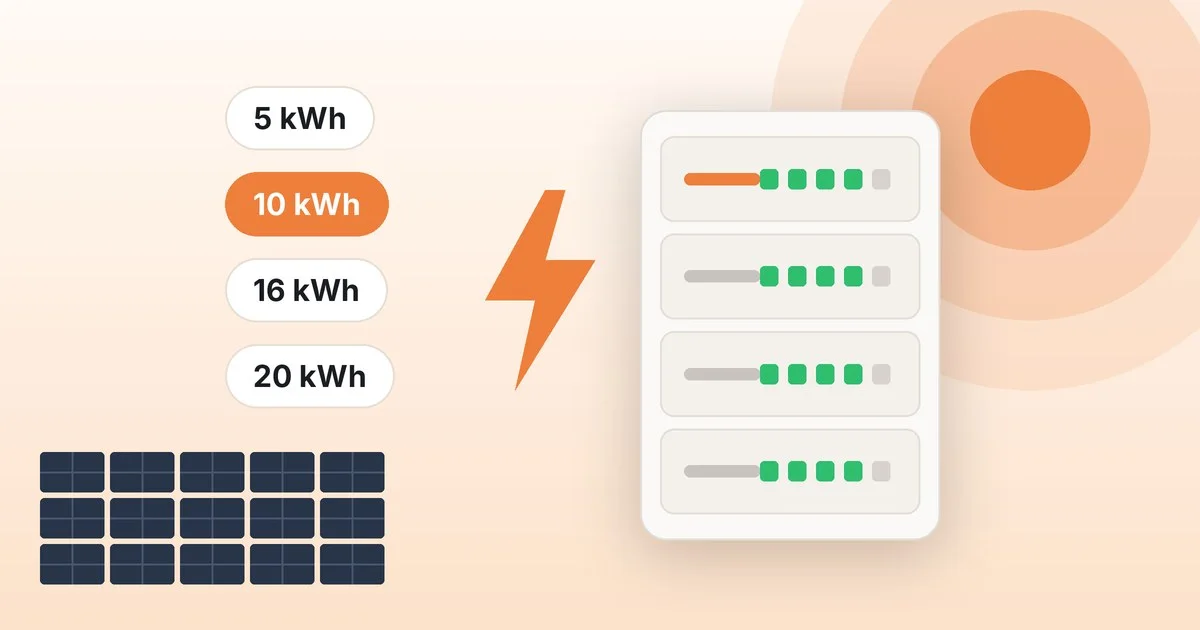
After inverter size, the second big question is battery capacity. A battery that is too small runs flat before midnight. One that is too large costs a lot and, in winter, your panels can't fill it. The right capacity depends on one thing: what you want the battery for.
1. Decide what you want from the battery
- Evening and night self-consumption – you use the energy your panels produce during the day after sunset too, instead of buying it from the grid.
- Backup during power cuts – you want the important appliances (fridge, boiler, lighting, internet) to keep running for a few hours without the grid.
- Off-grid system – there's no grid at all, and the battery has to cover the night and days with little sun.
2. Self-consumption: work out your evening and night use
Check how much you use from sunset to morning. If you have a smart meter or a monitoring app, the number is there. If not, a good estimate: in a typical home, about half or more of daily consumption happens in the evening and at night.
Example: a home using 12 kWh a day, about 7 kWh of it after sunset, needs a battery of around 8 kWh. Lumentree battery datasheets list a 90% depth of discharge (DoD), so divide your night-time use by 0.9: 7 kWh ÷ 0.9 ≈ 7.8 kWh.
3. Backup: add up only the essential loads
For backup you don't need to power the whole house, only what matters. Add up the power of the essential appliances and multiply by the number of hours you want to cover.
| Essential load | Typical average power |
|---|---|
| Fridge | 50 – 150 W (on average, including compressor starts) |
| Gas boiler (pump + controls) | 80 – 150 W |
| LED lighting | 50 – 150 W |
| Router, TV, phone charging | 50 – 150 W |
Example: 400 W average × 10 hours = 4 kWh. With the DoD margin, a 5 kWh battery covers a full night-time power cut for the essential loads.
4. Off-grid: think about winter
Without a grid, the battery has to cover night-time use and cloudy days as well. Systems are usually sized for 1 – 2 days of consumption, and the panels must be sized to recharge the battery in winter too. An off-grid system is best sized on your real numbers – write to us and we'll work it out together.
5. Also check how much power the battery can deliver
Capacity (kWh) tells you how long the battery lasts, while maximum current tells you how much power it can deliver at once. At 51.2 V:
- a 100 A battery delivers about 5 kW – for example the LT 5.1-S;
- a 200 A battery delivers about 10 kW – for example the LT 10.4-S, LT 16.0-S, LT 20.0-S and LT18.2-S-ND.
If you have an inverter of 6 kW or more and want to use its full power from the battery, choose a 200 A model or connect several batteries in parallel.
Indicative examples
| Situation | Capacity | Suitable batteries |
|---|---|---|
| Backup for essential loads or a small home, 3 – 5 kWh in the evening | 5 kWh | LT 5.1-S |
| Medium home, 6 – 9 kWh in the evening and at night | 10 kWh | LT 10.4-S |
| Large home, heat pump, 12 – 15 kWh at night | 16 kWh | LT 16.0-S or 2 × LT 10.4-S |
| Very high consumption or off-grid | 18 – 20 kWh and more | LT 20.0-S, LT18.2-S-ND or several in parallel |
Where does the battery go?
The LT-S and LT 20.0-S batteries are IP20 and go indoors. The LT18.2-S-ND has an IP65 enclosure and can also sit in unheated spaces such as a garage or outbuilding. Keep in mind that LiFePO4 batteries charge above 0°C – the exact ranges are in each model's datasheet.
You can start smaller
You don't have to buy all the capacity up front. Lumentree batteries connect in parallel – up to 15 units for the LT-S and LT 20.0-S, up to 32 for the LT18.2-S-ND – so you can add modules as your consumption grows. And Lumentree hybrid inverters also run without a battery if you'd rather add it later.
If you haven't settled on the inverter size yet, read the guide What size inverter do I need? as well.
Want a recommendation?
Send us the consumption from your bill, what you want the battery for (self-consumption, backup or off-grid) and the inverter you have or plan to buy, and we'll tell you which capacity fits. Request a quote or message us on WhatsApp at +40 712 348 437.